Catalysts for Growth: Boosting UK Growth Markets

10 mins
Download report ( Full Report)

The UK is a nation of entrepreneurs, with SMEs (small and medium-sized enterprises) accounting for 99.9% of the business population in the UK.1 Of those SMEs, high-growth companies represent over 50% of the total SME turnover.2 The UK ranks third in the world for the ease of doing business,3 has a highly skilled and diverse workforce and strong infrastructure to support innovation-driven businesses. Over 700 companies have shares traded on UK growth markets4 with a market capitalisation ranging from just a few hundred thousand to over £3bn. There are 13 million people in the UK with cash savings of approximately £430bn that could be proactively invested5,6, with more than four million people who want to take at least some form of investment risk.7 Taken together these factors create the ideal backdrop for growing companies.

However, while the UK has a strong record of building innovative growth companies, too many of them are choosing to continue their growth outside the UK. Despite their reputation for easier access to capital than on a main market, there is concern that UK growth markets8 have been overlooked by recent capital markets reforms. Recent market volatility has affected investor confidence; Liquidity concerns have made it harder for companies to trade shares and for investors to exit positions and a narrower pool of institutional investors has impacted price discovery. The lack of focus on the markets alongside these concerns has created a challenging environment for growth companies looking to go public in the UK.

To keep the value, innovation, jobs, tax revenue and economic growth that UK growth markets support we must treat them as a source of strength, building economic security for individuals across the country and supporting the governments drive for growth.

Throughout their lifetime, growth companies will access various equity and debt funding options as they grow and their business needs evolve. From bank loans, government-backed or regional schemes such as the Enterprise Investment Scheme (EIS), angel investors and venture capital, to private equity to public equity markets, the right funding option for a business depends on factors such as their stage of development, the sector in which it operates and its growthpotential. UK equity markets are one source of funding that can play a critical role in enabling entreprenuers up and down the country to build their businesses, create jobs, support their local communities and drive economic growth.
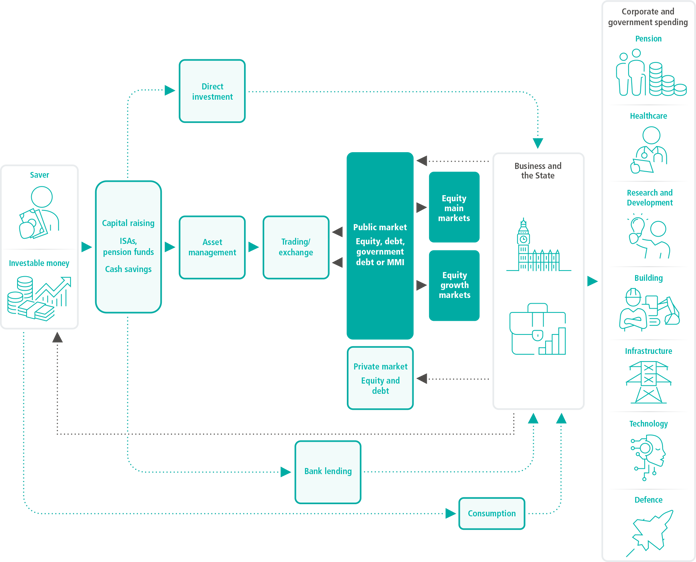
UK growth markets in the financial system

Recent UK capital markets reforms have come at a time of renewed focus from the government on improving the business environment. In parallel, the European market is experiencing an increase in the backlog of demand for listings, and geopolitical developments are leading innovative companies across the globe to consider which jurisdictions will best align with their values to support their strategic goals. This gives the UK a significant window of opportunity to assess and address actions that together can supercharge the growth and competitiveness of the UK’s growth markets.

As we approach the 30th anniversary of AIM, and as public markets are undergoing a period of introspection, this paper sets out the advantages of a healthy growth market environment for companies with high growth potential, why it matters to the UK. It also details 10 strategic enablers to strengthen UK growth markets and their contribution to the nation’s wider growth agenda. While the focus of this paper is on public equity markets, we briefly set out the strengths of the private capital markets and the interactions between those markets and public markets. The importance to the UK of other types of business financing and their potential contribution to the real economy should also be considered.

Across our industry, and among the organisations with whom we worked on this paper, there is growing evidence9 for the need to support and promote all parts of the UK’s capital markets landscape to drive growth across the government’s eight priority sectors as set out in its ‘Invest 2035: modern industrial strategy’ and increase returns for investors.

Conclusion

If the UK fails to nurture our important growth markets, it will limit access to capital for UK growth companies with ambitions and potential to scale up, inadvertently sending jobs, tax revenues and talent overseas. This would harm communities up and down the country and reduce opportunities for individuals and institutions to generate returns from investing in the UK. It would also constrain the ability of innovative startups to fund expansion and deliver products and services that could generate wider economic and social benefits to the UK and create jobs. Ultimately, failure to act will impact the UK’s competitiveness and capacity in emerging technologies and other sectors crucial to the its growth and resilience.

As the UK’s revolutionary listing regime changes start to have an impact, a pipeline of UK-based companies are moving through their maturity cycles and preparing to take the next step on their growth journey. To harness their potential and the positive impacts for the economy and society, government must act swiftly to ensure public markets - particularly growth markets - can continue to compete and evolve to support companies across the country to grow, develop and remain in the UK.

The health of the UK’s growth markets is the collective responsibility of all those who engage with them. TheCityUK stands ready to support the government and regulators in boosting the enabling role that growth markets can play across the UK economy.

1 TheCityUK, ‘Making the UK the leading global financial centre: An international strategy for the UK-based financial and related professional services industry’, (September 2021), p.10, available at: https://www.thecityuk.com/media/q0mewp0i/making-the-uk-the-leading-globalfinancial-centre.pdf
2 The UK Fast Growth Index, available at: https://www.fastgrowth50.com/
3 The Global Financial Services Index 36, available at: https://www.longfinance.net/media/documents/GFCI_36_Report_2024.09.24_v1.1.pdf
4 Barclays, ‘Over 600 on AIM and over 100 on Aquis’, (August 2024), available at: https://home.barclays/content/dam/home-barclays/documents/ news/Insights/Graduating%20from%20a%20Junior%20Stock%20Market%20in%20the%20UK%20FINAL.pdf
5 Based on Money and Pension Service (MAPs) view that 3-6 months’ worth of outgoings should be held in cash- but other savings really would benefit both individuals and the wider growth of the economy by being invested, available at: https://www.moneyhelper.org.uk/en/savings/ types-of-savings/emergency-savings-how-much-is-enough
6 Barclays, ‘Are there UK savers who could become investors that grow the UK economy?’, (September 2024), available at: https://home.barclays/ content/dam/home-barclays/documents/news/Insights/Final%20Report%20-%20Are%20there%20UK%20savers%20who%20could%20 become%20investors%20(digital%20version).pdf
7 The Centre for Policy Studies, ‘Retail Therapy’, (July 2023), available at: https://cps.org.uk/wp-content/uploads/2023/07/CPS-Retail-Therapy-FINAL.pdf
8 For this paper we have used the term growth markets but would highlight that regulatory definition is SME growth market
9 For example: UK Finance: Growth Escalator, The Quoted Companies Alliance: The future of smaller company capital markets, British Private Equity and Venture Capital Association (BVCA): Venture capital in the UK, City of London Corporation: The UK - a top destination for financial and professional services investment